
Question (April, 2023):
How do we discern churches that teach perspective from those that just share knowledge. The task of discerning presumes I know the difference. As I don’t, what are the markers I should look out for?

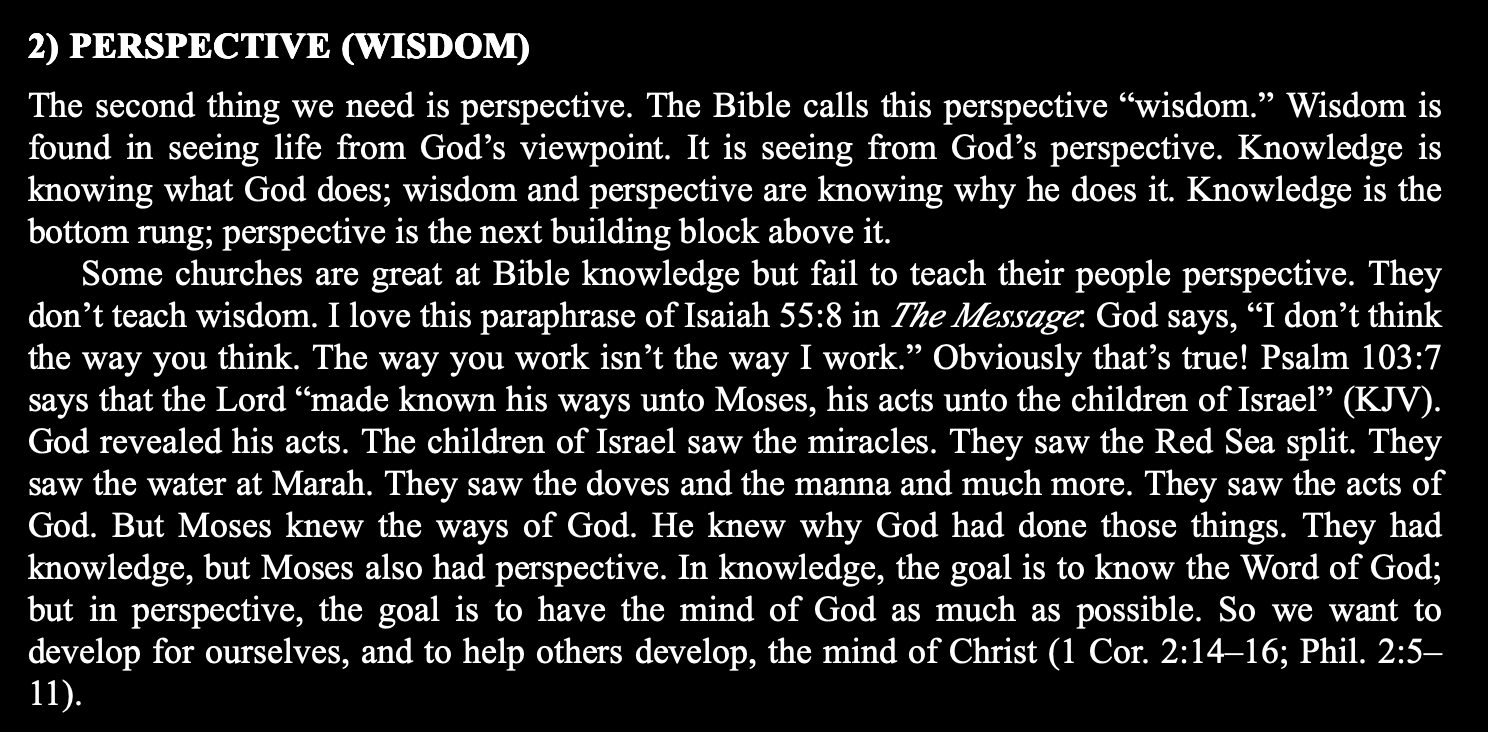
Context: An excerpt (reference below) was shared from the book “Thinking. Loving. Doing.: A Call to Glorify God with Heart and Mind” by John Piper, Thabiti Anyabwile, Francis Chan, David Mathis, R.C. Sproul, and Rick Warren.
Answer:
You’re right; discerning presumes you know the difference to some extent, and the first thing you should do for yourself is to understand what the “right doctrines” are as instructed in the Bible and how the Bible instructs us to look out for those things in churches (these correct doctrines are the foundations for teaching the “true knowledge and perspective of God”).
The Bible shows in different parts how God reveals Himself to certain people, but to others, He doesn’t. They see the acts, they see the miracles, but they never “see God”. This shows that there’s the right way to see God (this is the way Christians would), and there’s another way that “others” see God. Mark 8:27-30, II Tim 2:19, Luke 8:9-10, John 14:16-17, John 17:25, Ephesians 4:17-24.
“For the message of the cross is foolishness to those who are perishing, but to us who are being saved it is the power of God. For it is written: “I will destroy the wisdom of the wise, And bring to nothing the understanding of the prudent.” Where is the wise? Where is the scribe? Where is the disputer of this age? Has not God made foolish the wisdom of this world? For since, in the wisdom of God, the world through wisdom did not know God, it pleased God through the foolishness of the message preached to save those who believe. For Jews request a sign, and Greeks seek after wisdom; but we preach Christ crucified, to the Jews a stumbling block and to the Greeks foolishness, but to those who are called, both Jews and Greeks, Christ the power of God and the wisdom of God. Because the foolishness of God is wiser than men, and the weakness of God is stronger than men.” I Corinthians 1:18-25.
Christians (true, biblically saved Christians according to the standard of the Bible) see God for who He is and continue in a progressive process of sanctification, love for God and the things of God, and growth in the knowledge of God. They learn more about God and live their lives more like God to His glory. Romans 6:1-23, I Thessalonians 5:23-24, II Corinthians 3:16-18, I John 3:2.
The essential doctrines of Christianity are:
The doctrine of the person of Christ (God and Man).
The doctrine of the offices of Christ:
Priest (removal of the guilt of sin, annulling the formal commandment, and the superiority of a new, perfect, and eternal priesthood) Hebrews 7:11-28.
Prophet (asserts the kingdom of God) John 6:30-40, Hebrews 8:7-13.
King (the King and Lord of the new kingdom), Isaiah 9:6-7, Luke 21:25-28, Daniel 2:44-45.
A correct understanding of these doctrines will give a clear perspective of the truth about God and His relationship with humanity. The Bible's systemic and unified message is also evident as one studies and understands the doctrine of Christ. Jesus Christ is everything about Christianity, and the entire Bible revolves around this truth.
In 1 Corinthians 15:1-4, Paul outlines what the gospel is and its importance in embracing and sharing it with others. He reminds the Corinthians of the gospel he preached among them: “That Christ died for our sins in accordance with the Scriptures, that he was buried, that he was raised on the third day in accordance with the Scriptures.” This is the essence of the gospel. Paul also warns us to be wary of the many “false gospels” offered to the unsuspecting: “But even if we or an angel from heaven should preach to you a gospel contrary to the one we preached to you, let him be accursed. As we have said before, so now I say again: If anyone is preaching to you a gospel contrary to the one you received, let him be accursed”—Galatians 1:8-9. The pure gospel of Jesus Christ—His death on the cross for sinners and His resurrection to everlasting life—is central to the Christian faith.
So how, then, do you know a true Church that teaches the truth? You will know them by their fruits. “Beware of false prophets, who come to you in sheep’s clothing, but inwardly they are ravenous wolves. You will know them by their fruits. Do men gather grapes from thornbushes or figs from thistles? Even so, every good tree bears good fruit, but a bad tree bears bad fruit. A good tree cannot bear bad fruit, nor can a bad tree bear good fruit. Every tree that does not bear good fruit is cut down and thrown into the fire. Therefore by their fruits you will know them.” Matthew 7:15-20.
Their fruit is their lifestyle, their priorities, their teaching, and the effect of their ministry on the lives of their followers.
Test their fruit by comparing it with the fruit of the life of Jesus Christ and His apostles, and the stark difference will be apparent to anyone with spiritual discernment.
What they teach (the highest percentage of their teachings is filled with these):
They teach vanity (things that do not last) and earthly things. They also give their followers a license for immorality.
“Whose end is destruction, whose god is their belly, and whose glory is in their shame, who mind earthly things.” Philippians 3:18-19.
“For there are certain men crept in unawares, who were before of old ordained to this condemnation, ungodly men, turning the grace of our God into lasciviousness, and denying the only Lord God, and our Lord Jesus Christ.” Jude 1:4.
“For when they speak great swelling words of vanity, they allure through the lusts of the flesh, through much wantonness, those that are clean escaped from them who live in error. While they promise them liberty, they themselves are the servants of corruption: for of whom a man is overcome, of the same is he brought in bondage.” 2 Peter 2:18-19.
What they do not teach (the essential parts you should look out for—these are what sound Churches will teach):
Unlike Apostle Paul, they do not teach or preach Christ. “For we preach not ourselves, but Christ Jesus the Lord; and ourselves your servants for Jesus’ sake.” II Corinthians 4:5.
If you stay long with them, you will learn more about them (the preacher) and less about Christ. If you don’t see Christ more in a church, something is wrong. “John answered and said, “A man can receive nothing unless it has been given to him from heaven. You yourselves bear me witness, that I said, ‘I am not the Christ,’ but, ‘I have been sent before Him.’ He who has the bride is the bridegroom; but the friend of the bridegroom, who stands and hears him, rejoices greatly because of the bridegroom’s voice. Therefore this joy of mine is fulfilled. He must increase, but I must decrease.” John 3:27-30.
If you stay long under their teaching, you will have many exciting ideas and philosophies from the Bible, but your love and passion for Jesus Christ will not grow; rather, it will deteriorate.
You will be fired up by all kinds of principles and ideas from the Bible, but you will not grow deeper in the knowledge of Jesus Christ.
Your regard and honor for the pastor will increase, but your regard and honor for the Lord Jesus Christ will decrease.
Under their ministry, you will see Jesus Christ as a tool to be used as needed, not as the Lord God who deserves the complete surrender of your life and earthly ambitions.
Under such teaching, you will never desire to say like the Apostle Paul, “But what things were gained to me, these I have counted loss for Christ. Yet indeed I also count all things loss for the excellence of the knowledge of Christ Jesus my Lord, for whom I have suffered the loss of all things, and count them as rubbish, that I may gain Christ” Philippians 3:7-8.
In conclusion, as a believer, you’re to test every spirit with the doctrine of Christ as the Holy Spirit guides you. The task of testing also requires you to have the true Spirit in you, so the first test starts with you. Do you think you know and believe this truth in the excerpt below?
“Beloved, believe not every spirit, but try the spirits whether they are of God: because many false prophets have gone out into the world. Hereby know ye the Spirit of God: Every spirit that confesseth that Jesus Christ is come in the flesh is of God: And every spirit that confessed not that Jesus Christ is come in the flesh is not of God: and this is that spirit of antichrist, whereof ye have heard that it should come; and even now already is it in the world.” 1 John 4:1-3.
“Not every one that saith unto me, Lord, Lord, shall enter into the kingdom of heaven; but he that doeth the will of my Father which is in heaven. Many will say to me on that day, Lord, Lord, have we not prophesied in thy name? and in thy name have cast out devils? and in thy name done many wonderful works? And then will I profess unto them, I never knew you: depart from me, ye that work iniquity.” Matthew 7:21-23.