

People believe that work is just a means of earning a living and providing for their needs and those of their loved ones. But what is God’s perspective on work, and what should be the Christian attitude to it? The answer to this question will not come from me, nor will it come from you, but we will source the answer to this question from God’s own inspired Word, the Bible, which is profitable for teaching and instruction in righteousness 1.
One truth we will all agree on is that we spend more time at work than on any single physical activity except sleep, and some of us work more than we sleep or rarely even sleep. Right? For a quick exercise, take some time to think about how much time you spend at work each day and how much you sleep at night, on average.
The point is that we all work a lot, at least five days every week, and are committed to the work we do, either gladly or forcefully. I’m sure many of us have different reasons and motivations for why we work; maybe some of us don’t even have one and still can’t understand how we got ourselves into this “9-5 life” as we became adults and are probably wishing we could have a six-month vacation twice a year, as many sarcastically say :). But if we’re all spending this much time on something every day of our lives, wouldn’t it be of great importance to understand why we’re doing it, even if just out of curiosity?
One interesting fact is that neither your nation's government nor your employer created the concept of work. God, the creator of the entire world, including you and me, created work. It’s my goal and desire then that we not only satisfy curiosity in this essay but also, through God’s word, ask the one who created work what He intended when He created it, and that, upon receiving an answer to our questioning, our response and attitude toward work moving forward might be transformed.
Two sub-questions to answer the one main question of this essay:
What is Work?
What is God’s Purpose for Work?
What is Work?
According to the Cambridge Dictionary, work is defined as:
“An activity, such as a job, that a person uses physical or mental effort to do, usually for money.”
“The material used by someone at work, or what they produce.”
“A place where a person goes specially to do their job.”
Below are a few examples of what these definitions will look like:
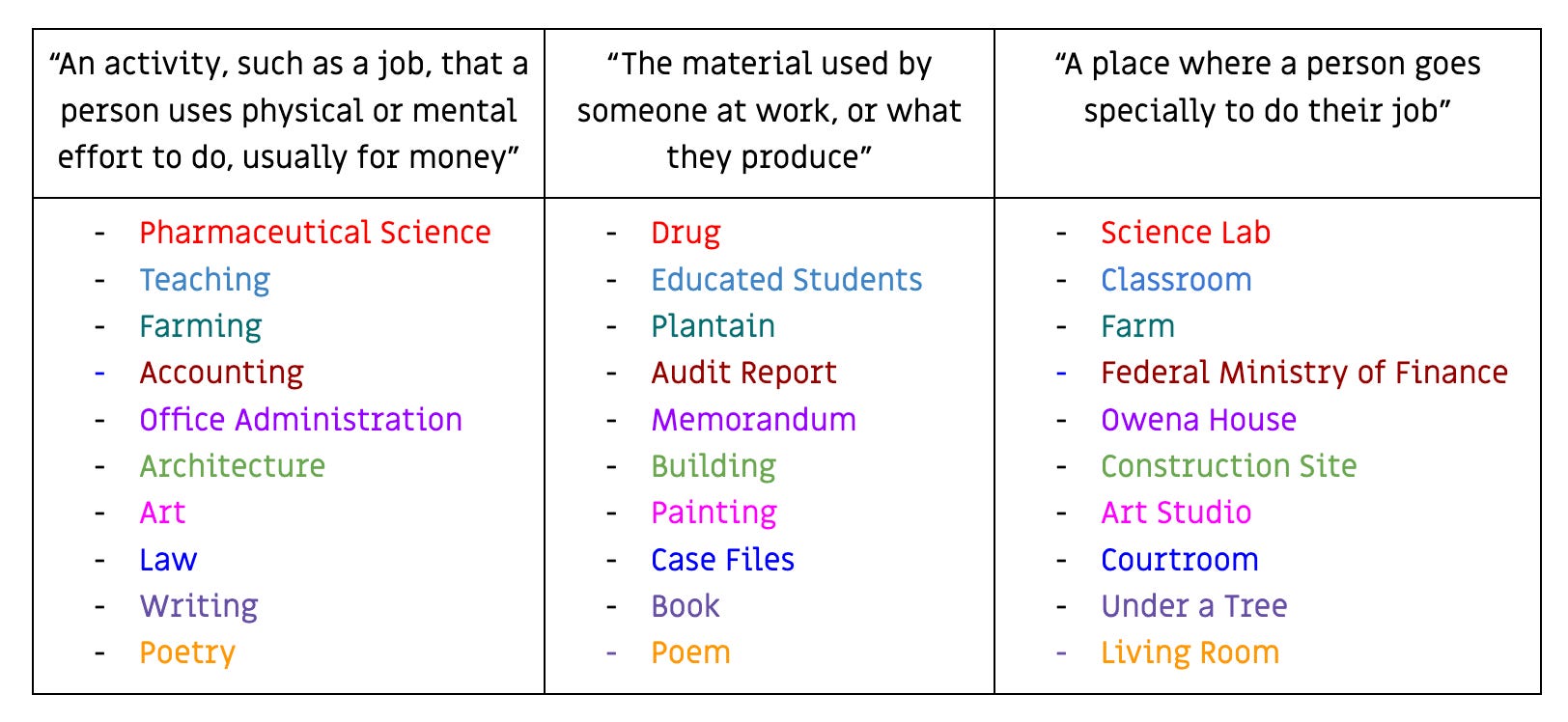
This is indeed a case of a polysemous or ambiguous word (a word that can have more than one meaning derived based on the context it’s used in). But either we’re referring to work as the activity, the product of the activity, or the location in which the activity occurs, work generally is:
An activity done by a person (usually an adult).
An activity that requires physical or mental effort.
An activity, usually done for remuneration (one-time, daily, weekly, monthly, etc.).
That said, what then is God’s purpose for work?
What is God’s Purpose for Work?
The title of this essay is “Is Work Only About Money?” and the use of the adverb “only” in that phrase already communicates that money is involved in work, and indeed it’s God’s design that we work to earn money, so we can:
Take care of our basic needs and those of our family (II Thessalonians 3:10-12 2, Genesis 1:29-30 3, I Timothy 5:8 4).
Take care of the needs of anyone else in need or unable to work (Ephesians 4:28 5, Titus 3:14 6).
But the purpose of earning or meeting needs is not the most important or primary purpose of work but rather a secondary reward and blessing we receive from God for having done the work He gave unto us. Adam was only able to continuously eat from the trees after he had worked the ground and kept it, as we will see shortly. But if work is not only and primarily about money, what then is it primarily about?
First, God created and commanded us to work, and work is a vital component of who we are, as we see in the book of Genesis:
26 Then God said, “Let us make man in our image, after our likeness. And let them have dominion over the fish of the sea and over the birds of the heavens and over the livestock and over all the earth and over every creeping thing that creeps on the earth.” 27 So God created man in his own image, in the image of God he created him; male and female he created them. 28 And God blessed them. And God said to them, “Be fruitful and multiply and fill the earth and subdue it, and have dominion over the fish of the sea and over the birds of the heavens and over every living thing that moves on the earth.” —Genesis 1:26-28 (ESV).
The Lord God took the man and put him in the garden of Eden to work it and keep it. —Genesis 2:15 (ESV).
God created Adam and gave him a specific task. Adam’s job was to work the ground and keep it in order. The same is true of us as descendants of Adam (Genesis 5:3 7). God has placed you here on earth, specifically in the city where you reside right now, because He has a task for you to accomplish. God created us to do something, to be fruitful, to cultivate, to keep, to steward, to contribute, and to produce. The word “dominion” here refers to being in charge of or ruling over something. God gives a portion of His creation to people to rule over as stewards and take care of. We are to work hard to care for what’s been entrusted to us, and our jobs present opportunities for us to have dominion over what God has created (just as earthly stewards do in earthly royal kingdoms for their kings, for example). But the confusion about work in our time stems mostly from a limited understanding of who we, as humans, are created to be and to do, and of the value and honour of work. But ultimately, work is crucial to fulfilling our chief purpose: glorifying and enjoying God forever 8.
But while God created us to work and to have dominion, He made us to do it as His image bearers. In Genesis 1:2, we see the world is dark, formless, and void. Then, God brings light, life, and order; He fills the world with goodness. God’s work in creation gives us an example of the nature of God that we should bear (God delights in good and order). Your work then is a special opportunity to image God by bringing goodness and order to others. We work because our Creator works; He has never ceased working and is still working (John 5:17 9), and we’re made in His image, to reflect Him. Traffic wardens are bringing order to roads, medical doctors are saving lives, parents are bringing order to the family unit, farmers are producing raw food items, chefs are processing raw food items, hawkers are making processed goods available to people, engineers are developing solutions, shoe cobblers are restoring footwear, pastors are shepherding souls, architects are building shelter, mechanics are bringing order to transportation, clerks are bringing order to the office, accountants are bringing order to financial records, and so on. Every job contributes to God’s design of work being the means of making discoveries about God’s world and sustaining life. Imagine what the world would look like if everyone had the same gifts and jobs?! We’re all playing our parts and contributing to sustaining order in God’s world.
Another thing to note as we proceed is that work did not come into existence as a result of the fall; the fall only made work more difficult than it already was. You might be familiar with the fall, but you can read about it in Genesis 3 (God gave Adam and Eve an instruction, and they disobeyed), and in verses 17-19, God placed a curse on man as righteous judgment for their disobedience.
17 And to Adam he said, “Because you have listened to the voice of your wife and have eaten of the tree of which I commanded you, ‘You shall not eat of it,’ cursed is the ground because of you; in pain you shall eat of it all the days of your life; 18 thorns and thistles it shall bring forth for you; and you shall eat the plants of the field. 19 By the sweat of your face you shall eat bread, till you return to the ground, for out of it you were taken; for you are dust, and to dust you shall return.” —Genesis 3:17-19 (ESV).
It’s a common misconception to think that because we work really hard now, we wouldn’t have had to work at all if the fall hadn’t happened; but we would have. The beautiful design we see in Genesis 1 was followed by a massive disruption of that design. Sin distorts all aspects of life and work; now Adam has to deal with thorns and thistles, and sadly, we do too.
But we truly cannot work and enjoy work the way God designed it to be enjoyed if we are not in relationship with Him as Adam was before the fall, no matter how much we earn. We have already seen that the fall made us work harder and added pain to work, but this wasn’t the only effect of sin on the world. Adam was separated from God and, by extension, you and I (as Paul puts it in Colossians 1:21, we have been “alienated” from God, shut out of fellowship and intimacy with God, estranged from life in Him… forever). Every descendant of Adam inherited this sin from Adam as David puts it in Psalms 51:5 “...in sin did my mother conceive me”.
But there is good news as Romans 5:6-19 reveals:
6 For while we were still weak, at the right time Christ died for the ungodly. 7 For one will scarcely die for a righteous person—though perhaps for a good person one would dare even to die— 8 but God shows his love for us in that while we were still sinners, Christ died for us. 9 Since, therefore, we have now been justified by his blood, much more shall we be saved by him from the wrath of God. 10 For if while we were enemies we were reconciled to God by the death of his Son, much more, now that we are reconciled, shall we be saved by his life. 11 More than that, we also rejoice in God through our Lord Jesus Christ, through whom we have now received reconciliation. 12 Therefore, just as sin came into the world through one man, and death through sin, and so death spread to all men because all sinned— 13 for sin indeed was in the world before the law was given, but sin is not counted where there is no law. 14 Yet death reigned from Adam to Moses, even over those whose sinning was not like the transgression of Adam, who was a type of the one who was to come. 15 But the free gift is not like the trespass. For if many died through one man’s trespass, much more have the grace of God and the free gift by the grace of that one man Jesus Christ abounded for many. 16 And the free gift is not like the result of that one man’s sin. For the judgment following one trespass brought condemnation, but the free gift following many trespasses brought justification. 17 For if, because of one man’s trespass, death reigned through that one man, much more will those who receive the abundance of grace and the free gift of righteousness reign in life through the one man Jesus Christ. 18 Therefore, as one trespass led to condemnation for all men, so one act of righteousness leads to justification and life for all men. 19 For as by the one man’s disobedience the many were made sinners, so by the one man’s obedience the many will be made righteous. —Romans 5:6-19 (ESV).
In Ephesians 2, we see that “For by grace you have been saved through faith. And this is not your own doing; it is the gift of God, not a result of works, so that no one may boast.” The only reason we would be able to truly enjoy work as we ought is that Jesus did the greatest work for you and me on the cross. Think about it: the work that God has called us to do, we are not even doing it perfectly; we mostly don’t make the best of our time, nor are we diligent enough; indeed, we can’t do perfect work pleasing to God. But Christ has done the perfect work, and when we come into Him, we can enter into the rest, and our work can then be an act of sacred worship.
We can then enjoy work as we ought, whether we earn little or much; we will be content. It becomes work for God out of love for God, as Colossians 3:23 shows us. Any time we attempt to rob God of His glory, we consequently rob ourselves of joy. As my pastor would often say, “When we operate in God’s design and wisdom, the fullness of His goodness and love will be experienced by us.” But we cannot operate in God’s design if we are not reunited to Him; God is calling you now to be reunited with Him. All you need to do is believe in the finished work of Christ and be saved. Perhaps God is calling you now; please do not hesitate and listen to Him.
For he says, “In a favorable time I listened to you, and in a day of salvation I have helped you.” Behold, now is the favorable time; behold, now is the day of salvation. —2 Corinthians 6:2 (ESV).
“Though our present work is a mixed bag of the good and the bad, the fulfilling and the frustrating, work was an integral part of God’s design even before sin and death intruded... Work is at the heart of our place and purpose within creation. Work, as designed in creation, must be seen as a contribution to God and His good world and not merely compensation. From cradle to grave, God designed us to contribute to God’s world and the common good—whether or not we receive a paycheck. The biblical definition of work is far more comprehensive than an economic transaction.” —Tom Nelson.
So please go to work from tomorrow, knowing that you are fulfilling God’s special purpose assigned to you. As John Macarthur puts it, “the love of work for work’s sake and the nobility of work as it once was”. As Christians, we don’t work for God to accept us or to meet God’s needs; we work because we’re already accepted, to meet the needs of others. Go to work, then be productive, and glorify God in your choice of work, discharge of work duties, and satisfaction in work. Grace and peace to you.
“All Scripture is breathed out by God and profitable for teaching, for reproof, for correction, and for training in righteousness” —2 Timothy 3:16 (ESV).
“For even when we were with you, we would give you this command: If anyone is not willing to work, let him not eat. For we hear that some among you walk in idleness, not busy at work, but busybodies. Now such persons we command and encourage in the Lord Jesus Christ to do their work quietly and to earn their own living.” —II Thessalonians 3:10-12 (ESV).
“And God said, “Behold, I have given you every plant yielding seed that is on the face of all the earth, and every tree with seed in its fruit. You shall have them for food. And to every beast of the earth and to every bird of the heavens and to everything that creeps on the earth, everything that has the breath of life, I have given every green plant for food.” And it was so.” —Genesis 1:29-30 (ESV).
“But if anyone does not provide for his relatives, and especially for members of his household, he has denied the faith and is worse than an unbeliever.” —I Timothy 5:8 (ESV).
“Let the thief no longer steal, but rather let him labor, doing honest work with his own hands, so that he may have something to share with anyone in need.” —Ephesians 4:28 (ESV).
“And let our people learn to devote themselves to good works, so as to help cases of urgent need, and not be unfruitful.” —Titus 3:14 (ESV).
“When Adam had lived 130 years, he fathered a son in his own likeness, after his image, and named him Seth.” —Genesis 5:3 (ESV).
Westminster Shorter Catechism
Q. 1. What is the chief end of man?
A. Man’s chief end is to glorify God and to enjoy him for ever.
“But Jesus answered them, “My Father is working until now, and I am working.”” —John 5:17 (ESV).